

That red patch near your injection site is probably not an emergency. Here is how to tell the difference, and what to track so your prescriber can act fast.
A red patch near your injection site stops you in your tracks. You notice it the morning after your weekly Mounjaro® shot, and suddenly you are wondering whether something is wrong, not how your weight loss is going.
The common assumption is that without a medical background, there is no way to tell a harmless local reaction from a dangerous allergic one, so the safest move is to panic or ignore it and hope it goes away. Any skin change on a new medication feels like a signal, and without context it is hard to know what it means.
According to the Mounjaro® FDA prescribing information, injection site reactions were reported in 3.2% of people taking Mounjaro® in placebo-controlled trials, compared with 0.4% on placebo. Most patients are told to expect nausea. The skin gets mentioned far less often.
A bump appears two days after the shot, or a raised, itchy patch shows up the morning after a step-up week, and there may be no mental frame for it. That can make the reaction feel like an emergency.
GLP-1 users may worry that a rash means they will have to stop the medication, and that worry can add stress on top of the skin issue itself. Our GLP-1 tracker can help you keep a record to share.
Noting when a reaction appears, where it sits relative to the injection site, and how long it lasts gives you a clear record to share with your prescriber, who can use it to judge any reaction. Pep AI keeps your shot days and injection sites in the dose log and your symptoms in a separate side effect log, so the details live in one app you can look back through.
Without a dated record, every new rash feels like the first one. With one, you start to see whether the reaction clusters around step-up weeks, a specific site, or a particular dose. That pattern is useful context for your prescriber.
Key takeaways
- A Mounjaro® rash is easier to talk through when you know its timing, so when it started after the shot is the first detail worth pinning down and sharing with your prescriber.
- Where a reaction shows up and whether it stays at the injection site are details worth noting; whether a reaction is routine or needs urgent attention is a question for your prescriber or healthcare provider.
- Tirzepatide acts on both GIP and GLP-1 receptors, and any injection can leave a local skin reaction, so it helps to note when one appears and talk it through with your prescriber.
- Rotating injection sites is one habit that can help; ask your prescriber or pharmacist about injection technique.
- Dose step-up weeks are worth noting; telling your prescriber whether a rash showed up after a step-up gives them useful context, and the label and your prescriber guide the dose steps.
- Your prescriber needs the dose week, injection site, the day the reaction started, and how long it lasted, not a photo and a rough guess, to make a useful clinical call.
- Pep AI's side effect log lets you pick from a built-in list of GLP-1 symptoms grouped by body area, or add your own, and rate how severe they were each day. Your doses and injection sites sit in a separate dose log, so you can look back through both and compare before your appointment.
What Actually Causes a Mounjaro® Rash at the Injection Site
Tirzepatide binds two receptors, GIP and GLP-1, but its chemistry is only part of the story with injection-site reactions. Many people on Ozempic®, Wegovy®, Mounjaro®, or Zepbound® feel unsure how to read a skin reaction, so contact your prescriber about any reaction that worries you.
When you don't have a clear record of exactly when you injected, where on your body the last shot went, and what dose you used, working out which shot came before a skin response becomes guesswork.
How Tirzepatide Triggers a Local Immune Response at the Injection Site
According to the Mounjaro® FDA label, injection-site reactions can occur with tirzepatide. A rash that spreads beyond the site means you should contact your prescriber right away, and any sign of a systemic allergic reaction needs emergency help, as covered below.
The physical puncture breaks capillaries, triggers a brief inflammatory cascade, and can leave a small raised welt even when the medication itself is tolerated well. Injecting into the same spot repeatedly concentrates that trauma, which is one reason the Mounjaro® label says to rotate injection sites with each dose. Knowing where your last injection went is also handy when you talk with your prescriber. Pep AI helps with injection-site rotation by marking your last site on the body map, listing your recent sites, and warning you if you pick the same spot as last time.
Why a Wet Alcohol Swab Can Be the Real Culprit Behind Injection-Site Redness
Isopropyl alcohol that has not fully dried before an injection may irritate the skin, so ask your pharmacist how to prepare your injection site. If you notice a red or stinging patch after a shot, note when it appeared and how long it lasted, and mention it to your healthcare provider.
A narrative review of how tirzepatide works explains the drug's dual action, but it cannot tell you what caused your rash. A precise injection log of time, site and dose is something you can bring to your prescriber, who can help work out what is causing a reaction.
How Injection-Site Reactions Look Different on Darker Skin Tones
Skin changes can look different across skin tones, and color changes can be harder to spot on medium to darker skin. Show any change to your healthcare provider, who can help you interpret what you see at the site.
When discoloration shows up and you are unsure how long ago your last shot was, Pep AI's dose log shows the date and time of each shot and the site you used. That gives your prescriber a clear reference point instead of a guess.
What Mounjaro® Injection Site Reaction Symptoms Actually Look Like
A small share of Mounjaro® users in the SURPASS clinical trials reported an injection site reaction, and Lilly's medical information reports that none of those reactions were severe.
The Four Classic Symptoms of a Normal Mounjaro® Injection Site Reaction
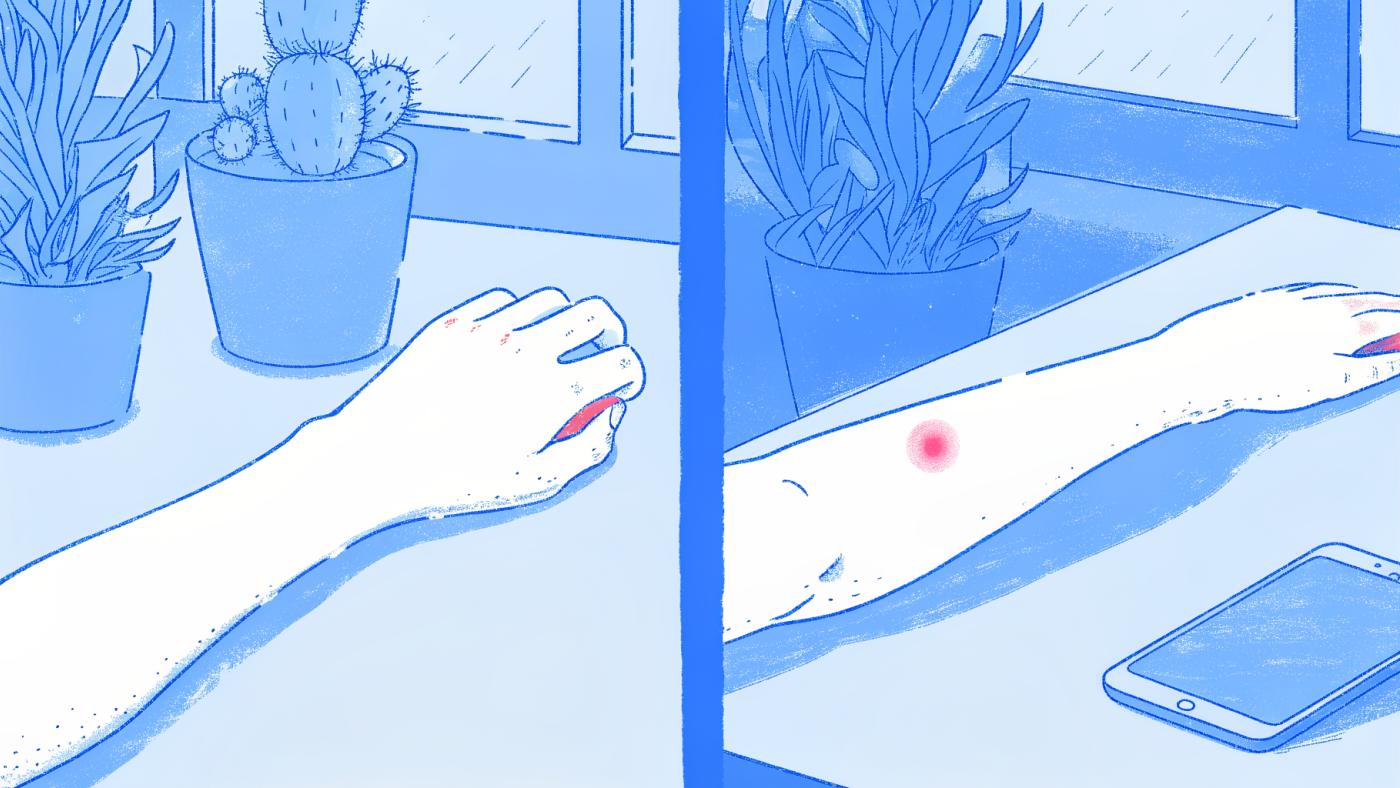
A typical Mounjaro® injection site reaction produces four symptoms: redness, mild swelling, itching, and a small raised bump confined to the needle entry point. Think of a pea-sized, slightly pink bump on the abdomen that feels warm and itchy to the touch on day one, then gradually fades without intervention.
The Fade Test
How a benign reaction behaves over time matters as much as how it looks. Note when it appears and how long it lasts, and contact your healthcare provider if a reaction looks alarming or you are unsure whether it is normal.
Contained vs. Creeping - The Boundary That Separates Local from Concerning
A local reaction stays small and stationary. A rash that spreads beyond the injection site means you should contact your prescriber right away, and a blistering rash or tightening in the throat needs emergency help, as covered below. Whether a reaction is local or something more is for your prescriber to decide, so share what you observe.
Many local reactions fade on their own, but some do not follow that pattern. Instead of fading, they spread, and that shift in geography is the first signal that something categorically different may be happening, which is exactly what the next section covers.
When a Mounjaro® Rash Signals a Generalized Allergic Reaction
Where a rash spreads is one of the most useful things to notice. A rash that stays close to the injection site may be a local reaction, but your prescriber or healthcare provider is the one to confirm that.
The Geography and Escalation Test - How Far Has the Rash Traveled
If hives appear anywhere beyond the injection site, including your torso, arms, or face, contact your prescriber right away. If they come with any of the emergency signs below, get medical help right away (call 911).
A 2025 Frontiers in Pharmacology meta-analysis of 48 randomized controlled trials compared side effects across GLP-1 medicines, but it focused on stomach and gut side effects rather than skin. For a rash, your medication's FDA label and your prescriber are better guides.
The practical test is simple: draw an imaginary boundary around the injection site. If the rash crosses it, contact your prescriber right away. If it stays inside and is shrinking, still mention it at your next check-in.
When to Get Emergency Help
Get medical help right away (call 911) if you have swelling of your face, lips, tongue or throat, trouble breathing or swallowing, fainting or feeling dizzy, a very fast heartbeat, or a severe rash or itching. A rash that spreads beyond the injection site without those signs means you should contact your prescriber right away.
The FDA prescribing information for tirzepatide lists serious hypersensitivity reactions, such as anaphylaxis and angioedema, and advises patients to seek medical attention promptly if they occur.
Widespread Blistering or Peeling Skin as a Separate Serious Signal
Blistering or peeling skin is a separate, potentially serious signal, so get medical help right away. Case reports in the GLP-1 class have documented reactions consistent with serious dermatological adverse events, including patterns resembling Stevens-Johnson syndrome, a condition requiring urgent hospital care. A blistering rash is not safe to monitor at home, regardless of whether breathing difficulty is present.
Related Reading
- Mounjaro® Injection Site Reaction
- Zepbound® Injection Sites
- Ozempic® Bruising
How to Manage and Prevent Mounjaro® Injection Site Reactions
Injection technique can play a role in recurring Mounjaro® injection site reactions, and reviewing yours with your prescriber or pharmacist costs nothing. The checklist below moves from immediate relief to structural prevention, so you have both a same-day action and a habit that may help reduce repeat reactions. If you are stepping up doses, note any new or stronger reactions in your log and share them with your prescriber; that is also a good time to review your injection technique.
How to Get Immediate Relief From Mounjaro® Injection Site Itching and Swelling
For a quick summary: a cool compress is a comfort measure people often ask about, so check with your prescriber or pharmacist, who can also advise on anything else for itching. Ask your prescriber before applying cream near broken skin. These options manage the symptom in the moment; the technique steps below address what may have caused it.
Why You Must Let Alcohol Fully Dry Before Your Mounjaro® Injection
To recap the single easiest fix: make sure the skin is clean and dry before inserting the needle. The FDA's tirzepatide prescribing information and the Instructions for Use that come with your pen explain how to prepare for each injection, so follow them and ask your pharmacist if anything is unclear. Letting the skin dry costs nothing and removes one easy-to-miss source of irritation.
How to Rotate Mounjaro® Injection Sites to Prevent Recurring Rashes
Repeated injections in one spot can irritate the tissue there, so returning to the same spot every week is worth avoiding. The Mounjaro® label lists the abdomen, the thigh, and the back of the upper arm (injected by another person) as injection areas and says to rotate injection sites with each dose. Ask your prescriber or pharmacist how far apart to space your sites. Tracking which site was used last is harder than it sounds without a log. When you log a shot in Pep AI, you tap the site on the body map, and the Home body map shows the sites you used over the last 4 weeks, with brighter spots for more recent shots, which helps catch rotation gaps over time.
1. Ask About a Cool Compress, Hydrocortisone Cream, or Antihistamines for Relief
When a Mounjaro® rash flares at the injection site, a cool compress, an over-the-counter hydrocortisone cream, or an oral antihistamine are options people commonly ask about. Ask your prescriber or pharmacist whether any of them is right for you, and follow the product label. These only ease symptoms, so a reaction that lasts or gets worse still needs a check from your healthcare provider.
2. Do Not Scratch the Injection Site - Scratching Worsens Irritation and Risks Infection
Scratching can break the skin, which may make irritation worse and raise the chance of infection. The urge to scratch is strong when a local reaction itches, and it can feel urgent in the moment. Resisting it matters because broken skin is easier to irritate further. Ask your prescriber or pharmacist what can safely ease the itch, especially if it persists.
3. Let Alcohol Fully Dry Before Injecting to Prevent Skin Irritation
A simple but frequently overlooked prevention step: after swabbing the injection site with an alcohol wipe, let the skin dry completely before using your Mounjaro® pen. Wet alcohol on the skin can sting and irritate, and waiting for it to dry takes only a moment. Ask your pharmacist if you have questions about preparing the site.
4. Rotate Injection Sites Across Abdomen, Thigh, and Upper Arm to Prevent Tissue Overload
Repeatedly injecting Mounjaro® into the same spot can irritate the tissue there and raise the chance of lingering redness or lumps. Rotating among the abdomen, thigh, and back of the upper arm, as the label directs with each dose, gives each area time to recover between doses. Some people find certain sites less comfortable, so ask your prescriber or pharmacist how to make rotation work for you.
5. Recognize Infection Warning Signs - Increasing Heat, Severe Pain, Pus, or Rapidly Expanding Rash
Injection site reactions can differ from person to person. A reaction that is getting worse instead of better, particularly one showing increasing warmth, severe or deepening pain, pus, or a rash border that is visibly spreading hour to hour, requires medical evaluation. Contact your prescriber right away if any of these appear; do not wait to see whether it settles on its own.
Why the Timing of a Mounjaro® Rash Is Worth Noting
Injection site reactions can show up in the days after a shot, and the timing is easy to lose track of when you are relying on memory of "sometime this week my skin flared up."

Why Step-Up Weeks and Overworked Injection Sites Are Worth Watching
Rashes may also seem to follow specific points in your schedule, such as a step-up week. Some people notice a rash after a step-up week and again after the next one. If you notice that sequence, write it down and share it with your prescriber, who can tell you what it means.
Recognizing that pattern depends entirely on knowing which dose was given and where it was injected. Pep AI's dose reminders and dose log help with that. You set a schedule and reminder time for each medication, and tapping a reminder opens that dose. The dose log shows each logged dose, so you can see when your logged dose changed. Keeping up with your shots and avoiding the same site twice in a row are the foundation of a rotation record that makes rash patterns readable.
The Calendar-Before-Cream Rule - Why Checking Your Shot Log First Produces Faster Answers
- Did I just step up my dose this week?
- Did this reaction appear at the same injection site I used last time?
Those two questions, answered with a written record rather than a reconstructed memory, turn a frightening unknown into something you can describe clearly. A rash that shows up two days after a Tuesday shot is a different detail from one that shows up the same day, and your prescriber can tell you what it means. Memory rarely holds that detail. A note of the day a reaction started, checked against your dose log, usually does.
Four Data Points That Make a Mounjaro® Rash Episode Clinically Useful
Four data points make a rash episode clinically useful: the shot date and dose, the injection site used, the day you first noticed the reaction, and a brief severity note. Together they give your prescriber a concrete record rather than a verbal summary filtered through days of anxiety.
Pep AI keeps your doses and injection sites in the dose log and your daily side effect ratings in their own log. On the Dose tab, a Side Effects trend chart sits next to the estimated medication level chart, above your dose history, so you can look back through both and compare. Once you spot a pattern, such as a step-up week or an overused site, you have something concrete to bring to your prescriber instead of reacting to each rash as a new emergency. A PDF report of your doses, injection sites and weight can help with that conversation too. That shift from alarm to informed observation is often the most useful thing you can bring to your next clinical conversation.
Related Reading
- Ozempic® Hair Loss
- Zepbound® Hair Loss
- Lump After Injection
Next steps
If your Mounjaro® rash keeps catching you off guard, the path forward starts with reading the pattern behind it, not just the skin in front of you. Local reactions can be easier to understand when you track dose steps and injection sites, two things you can observe and record on your own. Start with our GLP-1 tracker app.
If a reaction looks severe or is getting worse, contact your prescriber or healthcare provider, and a record of when it started can help that conversation. And because it is easy to misremember the timing and details of health events, a dated log can give you something concrete to share with your prescriber. Together, those two realities point to one next step: get the record started before the next shot, not after the next rash.
Start with the GLP-1 tracker app to log your doses and injection sites and rate your side effects each day, all in one app. Pep AI is free to try: a free download and a 3-day free trial on iPhone or Android, then a subscription.
Frequently Asked Questions
How common are injection site reactions with Mounjaro®?
They are a known, listed side effect. According to the Mounjaro® FDA prescribing information, injection site reactions were reported in 3.2% of Mounjaro®-treated patients in placebo-controlled trials, compared with 0.4% on placebo. Lilly's medical information reports that none of the injection site reactions in the SURPASS trials were severe.
How long does a Mounjaro® injection site reaction typically last?
The label does not give a typical duration, so ask your prescriber or healthcare provider about your own reaction. Logging the reaction and rating it each day in Pep AI gives you a dated record to share.
Why does the rash near my Mounjaro® injection site look purple or bruise-like instead of red?
Redness can look different across skin tones, and a reaction that looks purple, brown, or bruise-like is worth showing to your prescriber. Because color alone can be hard to judge, write down the shape, warmth, and tenderness of the area to share with them.
Does a small lump or raised bump at the injection site mean something is wrong?
Some people notice a small raised bump at the needle entry point after an injection, and it may look pink or feel warm or itchy. If a bump persists, gets larger or worries you, check with your prescriber or healthcare provider, and log it in Pep AI so you can share the details at your next appointment.
Why does rotating my injection sites actually matter?
Repeated injections in the same spot may irritate the skin there, which is why the Mounjaro® label says to rotate injection sites with each dose. Pep AI's body map helps you keep track of where your last injection went, and you can share your dose log with your prescriber.
Track it all in one app.
Pep AI keeps your GLP-1 shots, injection sites, food, side effects and weight in one app, with reminders on shot day. Download it on iPhone or Android.


This article is general information for people taking a GLP-1 medication. It is not medical advice, it does not recommend any medication or dose, and Pep AI is not a medical device. Talk to your prescriber about your treatment and any change to it.