
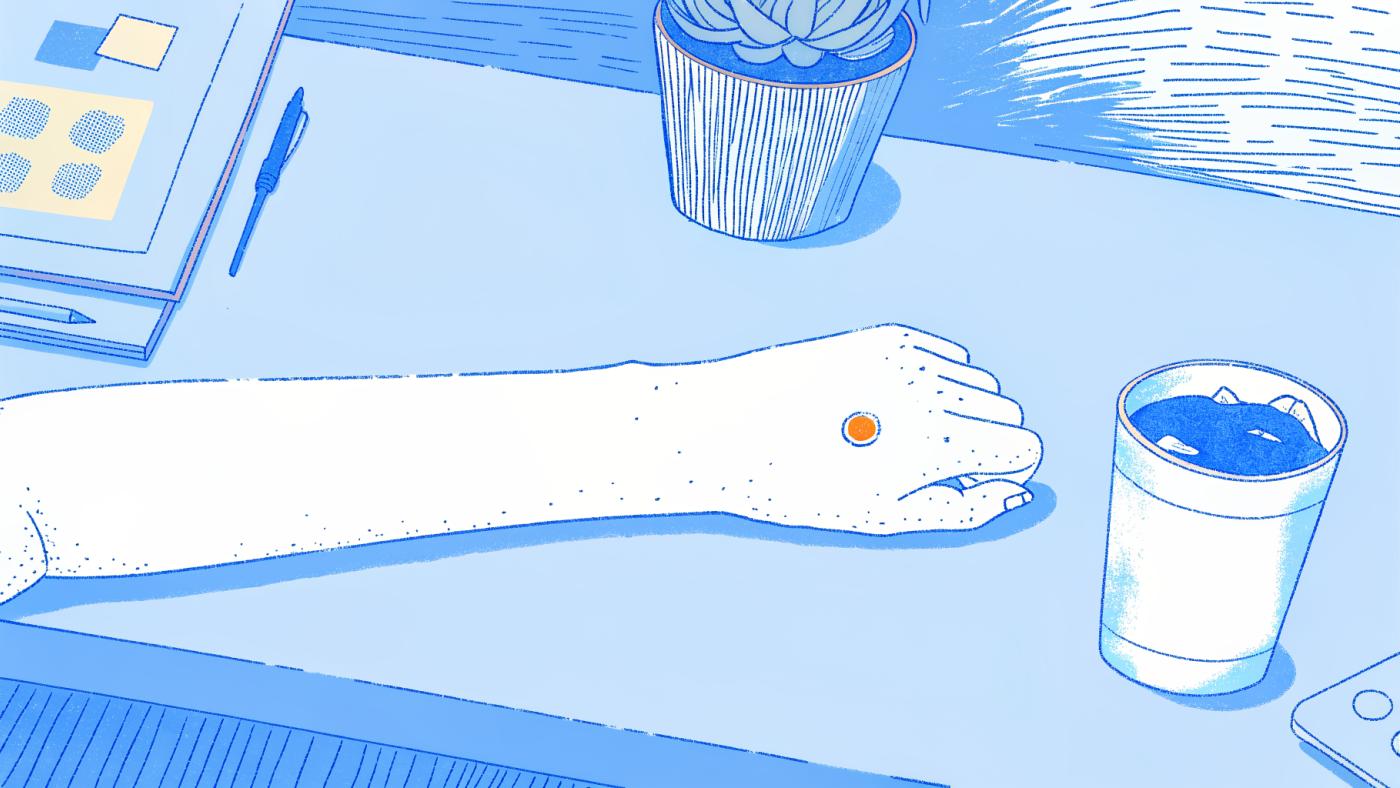
That red welt at your injection site is often a routine injection site reaction. Here is exactly what to look for, what it means, and the one signal that tells you to stop waiting.
A red patch at your injection site can send your brain straight to worst-case territory. It is easy to assume that all injection site rashes on medications like Ozempic®, Wegovy®, Mounjaro®, or Zepbound® are the same thing, so the same response, either "wait and see" or full-on panic, applies every time. It does not. Injection site reactions are listed as a reported side effect in the FDA labels for tirzepatide medications, and your prescriber is the right person to tell you what a specific reaction means. Our GLP-1 tracker can help you keep a record to share.
A tirzepatide injection site reaction looks like a small, localized disturbance at or very close to the needle entry point. Injection site reactions are listed in the FDA labels for tirzepatide medications, and they are often described as a patch of redness near the needle entry point, sometimes with mild swelling or a small raised welt. It may feel warm to the touch, itch, and occasionally form a small firm nodule under the skin, about the size of a pea, that you can feel more than see.
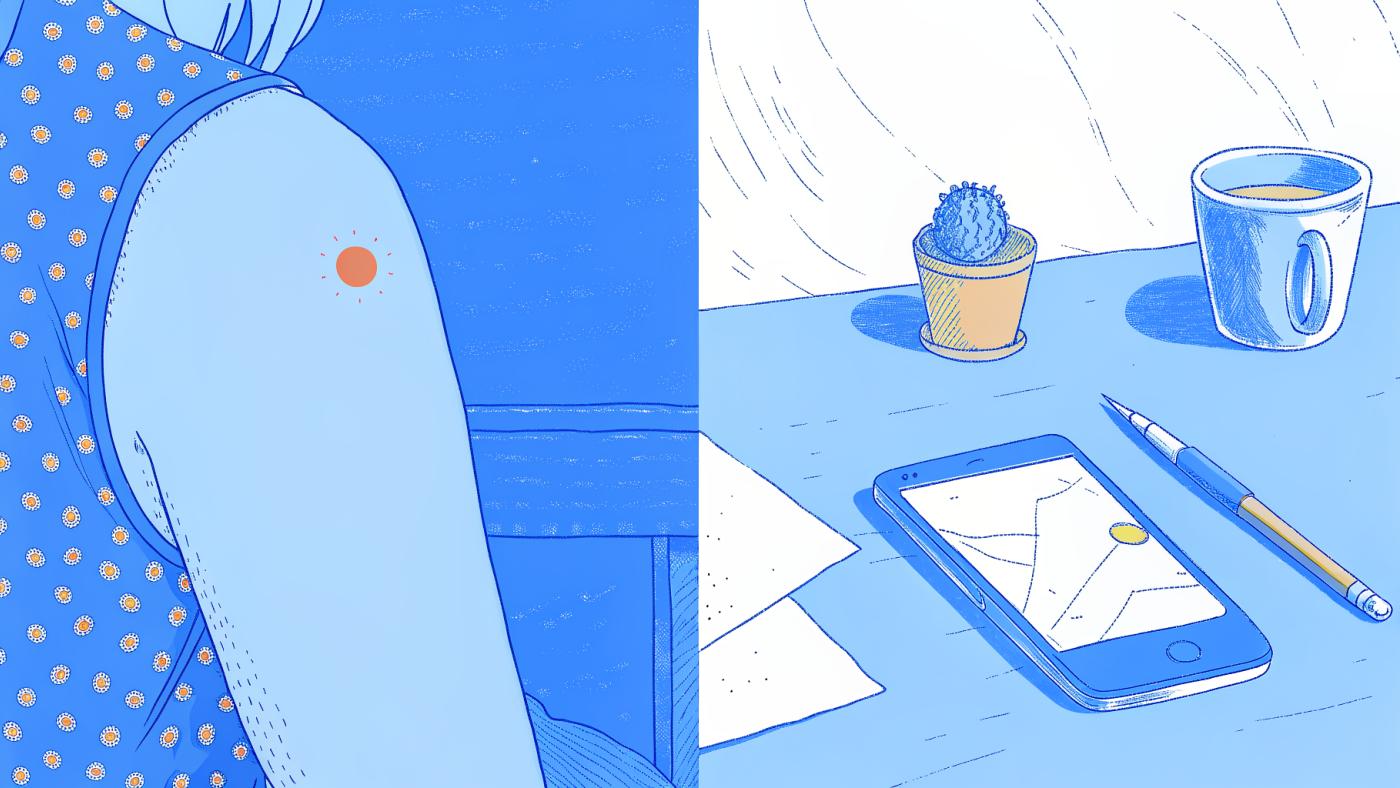
The key word is localized. The key question is whether the redness and swelling stay at the site. If redness or swelling spreads beyond the site, raise it with your prescriber.
Telling a routine injection site reaction apart from something more serious is a decision for your prescriber, so describe what you see and ask. The FDA labels list injection site reactions as a reported side effect. A reaction that stays inflamed much longer than usual is also worth flagging.
Whether a reaction is a reason to change or stop treatment is a decision for your prescriber, not something to settle on your own.
A common assumption is that reactions are a "starting problem" that fades once the body adjusts. In practice, some people notice reactions changing around a dose step-up, which is worth logging for your prescriber.
Someone stepping up to a higher dose might notice a raised welt that looks worse than anything they saw at the start. Whether it is expected is a question for your prescriber. Once you can name what you're looking at, a localized welt rather than a systemic alarm, the next question becomes obvious: why does tirzepatide trigger this response in the first place?
Key takeaways
- Injection-site rashes with tirzepatide are often localized, but a rash is not something to self-diagnose, and any decision about continuing treatment belongs with your prescriber.
- A rash that spreads beyond the injection site means you should contact your prescriber right away. Swelling of your face, lips, tongue or throat, trouble breathing, or other signs of a serious allergic reaction mean you should get medical help right away (call 911).
- If you notice a reaction at the injection site, ask your prescriber or pharmacist how to care for it, and avoid guessing what is happening under the skin.
- Skin reactions with tirzepatide can look very different from person to person, and your prescriber is the right person to tell you what is behind yours.
- Rotating injection sites is a common practice, and logging where each shot went can help you and your prescriber notice if reactions keep showing up in the same spot.
- A rotation plan is straightforward on paper, but keeping it up week after week without a written record is hard, and a record makes repeat reactions easier to spot.
- Pep AI lets you log the injection site with each dose and rate your side effects each day, in separate logs you can look back through and compare, so repeat rashes are easier to spot than when you try to reconstruct them from memory.
Why Tirzepatide Causes Injection Site Rashes
The skin and underlying tissue can respond to the drug itself, to other ingredients in the formulation listed on the Mounjaro® and Zepbound® labels, and to the mechanical trauma of the needle.

Possible Drivers Behind Tirzepatide's Skin Reactions
Tirzepatide injection site rashes happen because subcutaneous tissue responds to a foreign molecule with a localized immune event.
- The drug molecule itself, which the skin may respond to with a local immune reaction
- Other formulation ingredients in Mounjaro® and Zepbound®, which are listed in each product's FDA label
- Needle trauma, which triggers a micro-inflammatory cascade regardless of what the needle carries
Because these three drivers can combine in different ratios, reactions are not one uniform phenomenon.
Individual responses differ from person to person, which is why the same pen and the same injection day can look different for two people, and your prescriber can advise on yours.
Does Cold Medication From the Fridge Affect Skin Irritation?
The Mounjaro® and Zepbound® pen Instructions for Use say it is not necessary to warm the pen to room temperature, so follow those instructions. Questions about vasoconstriction and similar effects are best raised with your pharmacist.
Compounded vs. Brand Tirzepatide and How Semaglutide Compares
Compounded tirzepatide is not the same product as branded Mounjaro® or Zepbound®, and Pep AI does not encourage its use, so if you have a reaction, ask your prescriber about the specific product you were prescribed. Semaglutide (Ozempic®, Wegovy®) is a single GLP-1 receptor agonist, while tirzepatide is a dual GIP/GLP-1 agonist.
A GLP-1 tracker app like Pep AI lets you log side effects by day and rate how severe they were, in a log separate from your doses. You can look back through both and show your prescriber how often a welt comes back.
How to Distinguish a Localized Rash from a Systemic Allergic Reaction
FAERS disproportionality data confirms that injection-site reactions are reported as a separate category from systemic allergic reactions, and clinical trial data from SURMOUNT-1 show injection-site reactions in a small share of tirzepatide participants. How a reaction changes over time matters too. Note the direction and speed of change, and share both with your prescriber.
A welt that looks alarming at hour two but is shrinking by hour six is a different situation from a mild pink patch that is still growing at hour 48, so describe the direction of change to your prescriber.
The Site Boundary Rule
Where a reaction spreads is an important detail to note and report to your prescriber. A localized injection-site reaction stays confined to the injection site. Redness, itching, and a small raised area that remain within a few centimeters of the needle entry point are often described as a localized injection-site reaction, and your prescriber can tell you what to expect.
A reaction that crosses that boundary is different. If a rash or hives spread beyond the injection site, contact your prescriber right away. The signs in the next section need emergency help.
When to Get Emergency Help
Get medical help right away (call 911) if you have swelling of your face, lips, tongue or throat, trouble breathing or swallowing, fainting or feeling dizzy, a very fast heartbeat, or a severe rash or itching. A rash that spreads beyond the injection site without those signs means you should contact your prescriber right away. The tirzepatide prescribing information describes serious allergic reactions, including anaphylaxis, and this case report describes one.
Call your prescriber (non-urgent) if the reaction stays at the site but is unusually large, lasts longer than a few days, or returns at the same location on consecutive injection cycles.
The Ambiguous Middle, Generalized Itching and the Compounded Tirzepatide Variable
Generalized itching without visible hives or swelling occupies genuinely uncertain territory. If itching remains the only symptom, contact your prescriber for guidance rather than waiting it out.
The uncertainty compounds further if you are using compounded tirzepatide rather than the branded formulation. Compounded formulations may use different excipients, buffers, or preservatives, differences that are clinically relevant when identifying what drove a reaction. If you use compounded tirzepatide and experience any skin response, your prescriber needs to know the specific formulation, not just the drug name.
Pep AI keeps your doses and your side effects in separate logs that you can look back through and compare. On the Dose tab, a Side Effects trend chart sits next to the estimated medication level chart, above your dose history, which gives you and your prescriber something factual to look at instead of a stressed reconstruction.
Step-by-Step Management Strategies for a Mild Tirzepatide Rash
Ask your prescriber or pharmacist what, if anything, to use. Grabbing ice, a cream, and a Benadryl all at once feels thorough, but using several things at once can make it harder to tell how a reaction is actually progressing.
1. Do Not Rub the Injection Site Immediately After Injecting Tirzepatide
The reflex to rub after injecting feels harmless, but rubbing may irritate the skin. Ask your prescriber or pharmacist what to do after the pen is removed, and follow your pen's Instructions for Use.
2. Ask About a Cold Compress as a No-Medication First Response
If you notice warmth or swelling after an injection, ask your prescriber or pharmacist whether a cool compress is right for you and how to use it. If you do use a cold pack, keep a cloth between it and your skin.
3. Ask About Topical Hydrocortisone Cream or a Topical Antihistamine
If redness or a raised welt persists, ask your prescriber or pharmacist whether an over-the-counter topical product is right for you. They can also explain how long to use it at one site, including around your next Zepbound® or Mounjaro® shot day, and whether other options make sense for itch or redness.
4. Ask Your Prescriber About Oral Antihistamines Such as Cetirizine or Diphenhydramine
Cetirizine (Zyrtec) and diphenhydramine (Benadryl) are different medications that are not interchangeable, and diphenhydramine can cause drowsiness. Ask your prescriber or pharmacist which, if either, is right for you, and follow the product label. If your reactions have been consistent week over week, bring a record of the days they happened and ask whether any medication before or after injections makes sense for you.
5. Know How Common Reactions Are and When to Call Your Prescriber
Across the SURMOUNT-1 clinical trial, injection site reactions were reported in about 3% to 6% of tirzepatide participants depending on dose, compared with 0.3% on placebo, according to Lilly's medical information. The Zepbound® FDA label, which pools SURMOUNT-1 with a second trial, lists injection site reactions in 6% to 8% of Zepbound® patients, compared with 2% on placebo. In other words, this is a known, reported side effect. If a reaction worsens or keeps spreading, contact your prescriber, who can guide any treatment decisions, including whether any cream or medication makes sense for you. Rating your side effects each day in Pep AI's side effect log turns scattered weekly observations into a dated record you can share. Jotting down where a reaction sits and how big it is helps too.
6 to 8 percent
of Zepbound® trial participants had injection site reactions (FDA label)
Related Reading
- Mounjaro® Injection Site Reaction
- Zepbound® Injection Sites
- Ozempic® Bruising
How to Rotate Injection Sites to Prevent Tirzepatide Rash Before It Starts
Rotation is a practical habit worth building, and your prescriber or healthcare provider can advise on injection-site reactions. SURMOUNT-1 trial data reports injection-site reactions among tirzepatide users, so it helps to keep a record of where each shot goes. A clear record can help you spot patterns, and a site rotation log is a good place to start.

How Far Apart and How Often to Rotate
Ask your prescriber how far to space injection sites and how often to rotate, and follow the prescribing information for your medication. A record of where each injection went makes it easier to follow that guidance and to share it at your appointments.
Spacing advice can sound precise, but without a record it is easy to misjudge where your last shot went. A log of each site makes it easier to follow what your prescriber advised.
Tirzepatide's Three Approved Injection Zones and How to Rotate Them
The Mounjaro® and Zepbound® prescribing information lists three injection areas: the abdomen, the thigh, and the back of the upper arm, which the label says another person should inject. The labels also say to rotate injection sites with each dose.
A simple log can show how you have moved between those areas, for example left abdomen, right abdomen, left thigh, right thigh, though your prescriber should guide your actual rotation plan, including how to rotate within and between areas over time.
Pen needle and device questions are best answered by your prescriber or pharmacist and the product's instructions for use.
If reactions seem to show up more at one site, note it and share it with your prescriber. That does not mean the site has to be avoided. It is something they can help you weigh.
Why Guessing Without a System Compounds Tissue Irritation Week Over Week
Lipohypertrophy, the thickening and hardening of fat under the skin at injection sites, has been reported with repeated injections. Most of the research comes from people with diabetes who inject insulin, where not rotating sites has been linked to lipohypertrophy. One 2011 study of 119 children and adolescents with type 1 diabetes found that 54.9% of patients developed lipohypertrophy, showing how widespread this complication can be in this population. If you notice lumps or hardened areas, mention them to your prescriber or healthcare provider.
Tirzepatide is a different medicine from insulin, so those numbers do not apply directly, but they show why tracking where you inject is worth the effort. The problem is often invisible, and that invisibility is the natural limit of relying on recall for a task that requires a precise spatial record across a four-week cycle.
That gap, between knowing the rotation rules and proving you followed them, is what Pep AI's injection tracking is built to help with. When you log your shot, you tap the site on Pep AI's interactive body map, and the dose log records when each shot was taken and which site you used, so you do not have to reconstruct your injection sites from memory. A rotation record that exists only on paper is hard to check; one you can review week over week is easier to bring to your prescriber.
Pre-Injection Habits That Make Each New Site Less Reactive From the First Stick
Ask your prescriber or healthcare provider, and check your medication's official label, for injection technique guidance.
Look at the site before each injection, and follow your pen's Instructions for Use about skin that is irritated, bruised or firm. If you notice firmness under the skin, mention it to your prescriber.
Most patients intend to follow these steps but rely on memory that degrades by shot day. When you log a shot in Pep AI, you tap the site on the body map. The Home body map shows the sites you used over the last 4 weeks, with brighter spots for more recent shots, and Pep AI warns you if you pick the same spot as last time. Pep AI is free to try: a free download and a 3-day free trial on iPhone or Android, then a subscription.
The next section shows why a structured digital log is the difference between a system that works and a good intention that fades by dose three.
Track Every Injection Site So Your Skin Stops Paying for Your Memory
Knowing how to rotate your injection sites is the easy part. Following it week after week without a single written record is much harder.

Why Relying on Memory Alone Can Lead to Repeated Injection Site Reactions
Memory is a poor rotation log. Without a timestamped record of which zone was used and when, it is easy to return to the same area without realizing it, and a prescriber can help with any reactions that keep recurring. It is easy to feel certain you have been rotating, then find, once you start writing things down, that one area has been carrying most of the load for weeks. The pattern was invisible until the record made it visible.
How a Timestamped Site Log Turns Reaction Patterns Into Actionable Evidence
Notes apps and calendar reminders are the informal workarounds many people start with. Pep AI keeps your doses, injection sites and side effects as separate logs in one app that you can look back through and compare. A specific logged entry is evidence, while a vague sense that you rotated is assumption. When you can compare where each shot went with the days you logged a reaction, a pattern that felt random becomes something you can show your prescriber. Logging turns a vague complaint into structured data.
Consistent Logging as the Accountability Layer Between Clinical Advice and Real Life
Worth noting: the app works best for users who log consistently; sporadic entries still leave gaps a prescriber cannot interpret. On iPhone only, the Lock Screen Live Activity, the large Next Dose widget (iOS 17 and later) and the Apple Watch app offer one-tap dose logging, which can make the habit easier to keep.
A rotation map and a reaction log only help if you keep them current. Get your first injection logged today.
Next steps
If a welt keeps appearing in the same spot week after week, your prescriber is the right person to ask, and a log of your shot dates and sites gives them something concrete to review. A reaction that keeps spreading is a reason to contact them right away, and a dated record helps you describe what happened.
Injection sites that get used repeatedly can become irritated, so keeping track of where each shot went matters. At the same time, the hard part of rotation is usually not knowing the rules but keeping track of them week after week. Those two facts point to the same correction: a timestamped record of every injection site, not a good intention that fades by dose three.
Start your first log with the GLP-1 tracker app from Pep AI. When you log each shot, you tap the site on the body map, so the dose log records which site you used and when. You can also bring your prescriber a PDF report of your doses, injection sites and weight instead of a stressed reconstruction.
Frequently Asked Questions
Why does tirzepatide cause a rash at the injection site?
Injection site reactions are listed as a possible side effect in the Mounjaro® and Zepbound® FDA labels. People often notice redness, itching or swelling around the injection area, so note the day they start and how they change, and share that with your healthcare provider. The labels also list the ingredients in each product, so ask your pharmacist if you have questions about what might be irritating your skin.
Can I use a cold compress to treat a tirzepatide injection site reaction, and how exactly should I apply it?
A cool compress is commonly discussed for mild warmth and swelling at an injection site, but ask your prescriber or pharmacist whether it is right for you and how to use it. If you do use one, keep a cloth between the pack and your skin, because direct ice contact can irritate skin that is already sore.
Is it okay to take an antihistamine before my tirzepatide injection to prevent a rash?
That is a question for your prescriber, not the app. If your reactions have been consistent week over week, log the days they happen and how severe they were in Pep AI and bring that record to your prescriber, who can advise on whether anything, such as an over-the-counter antihistamine, is right for you and how the options compare.
How long should I use hydrocortisone cream on a tirzepatide rash?
Ask your prescriber or pharmacist whether an over-the-counter hydrocortisone cream is appropriate for you, and follow the directions on the product label and their advice on how long to use it. Logging each shot and rating any skin reaction by day in Pep AI gives you a dated record to share at your next appointment.
How do I know if my tirzepatide rash is a normal injection site reaction or a dangerous allergic reaction?
Where the reaction sits and how it changes over time are useful details to note, and your healthcare provider can tell you whether a reaction looks routine. Get medical help right away (call 911) if you have swelling of your face, lips, tongue or throat, trouble breathing or swallowing, fainting or feeling dizzy, a very fast heartbeat, or a severe rash or itching. A rash that spreads beyond the injection site without those signs, or one that keeps getting worse, means you should contact your prescriber right away.
Track it all in one app.
Pep AI keeps your GLP-1 shots, injection sites, food, side effects and weight in one app, with reminders on shot day. Download it on iPhone or Android.


This article is general information for people taking a GLP-1 medication. It is not medical advice, it does not recommend any medication or dose, and Pep AI is not a medical device. Talk to your prescriber about your treatment and any change to it.