
Peptide Tracker for Doses,
Vials & Cycles
The all-in-one app for tracking peptides — doses, vials, cycles, and injection sites in one place.


Published by Pep AI · Peptide tracker · Updated July 2026
Most people start tracking peptides in a notes app or a spreadsheet, then quietly give up. A real protocol has too many moving parts to hold in your head: which compound, what dose, how many units that works out to after reconstitution, how many days are left in the vial, where the last injection went, and where you are in an on/off cycle.
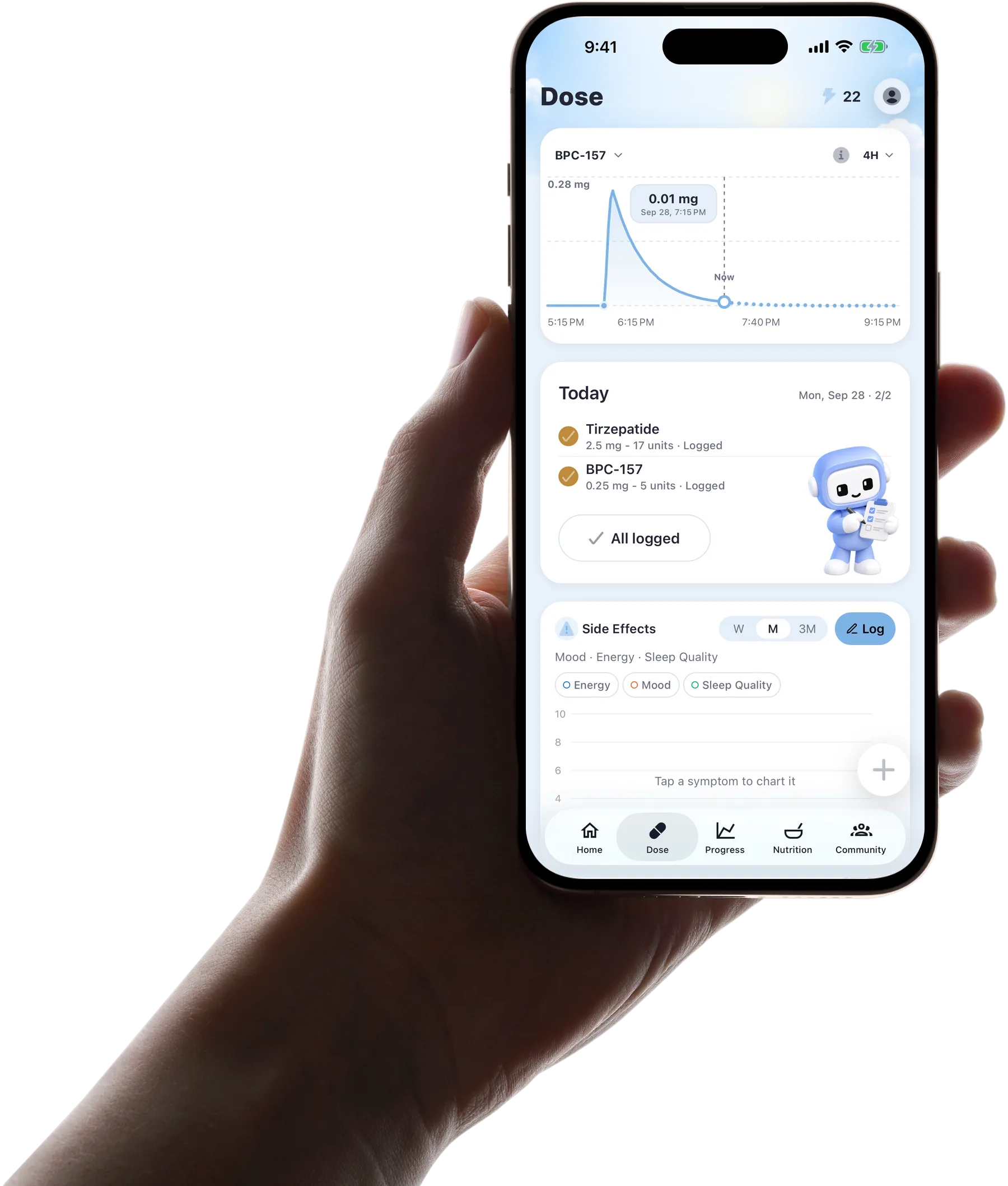
Pep AI keeps all of it in one place. Add a peptide, enter your vial details and the dose you take, and it keeps supply and schedule up to date. Log a dose in one tap, rotate injection sites automatically, watch your estimated level rise and fall, and let your history build in the background. Because it's built for peptides — not just GLP-1s — it handles stacks and cycles the way people actually run them.
And when you have a question about a compound, a dosing window, or a half-life, Pep Bot is a research assistant trained on peptide science, available any time. Pep AI is not a medical device and does not give medical advice — it's the tracking and organization layer around your protocol.
Everything a peptide protocol needs, in one app
Pep AI keeps the moving parts of a protocol together, so nothing lives in a spreadsheet or your memory.
Doses & schedules
Daily, every-other-day, or fully custom. Get a reminder when it's time, log it in one tap, and your history builds itself.
Vials & reconstitution
Record each vial, the water you added and the dose you take, and Pep AI keeps doses left and reorder timing up to date — no spreadsheets.
Cycles & stacks
Track on/off cycles and multi-compound stacks with the cycle length and off-weeks you actually run.
Injection sites
Automatic site rotation so you always know where the last shot went and where the next one should go.
Estimated levels
See your estimated compound level rise and peak between doses, based on your schedule and half-lives.
Pep Bot
An AI research assistant trained on peptide science — ask about compounds, dosing windows, or half-lives any time.
Frequently asked questions
Is Pep AI a good peptide tracker?+
Pep AI is built specifically for peptide protocols — doses, vials, reconstitution, cycles, stacks, and injection sites in one place — rather than being a generic reminder app. It's been downloaded over 200,000 times and is rated 4.8 stars on the App Store.
Can it track more than GLP-1s?+
Yes. Pep AI tracks any peptide — GLP-1s like semaglutide and tirzepatide, plus compounds like BPC-157, GHK-Cu, MOTS-c, retatrutide, and more.
Does it do reconstitution math?+
No. Pep AI does not calculate doses or syringe units. You record the vial, the water you added and your dose in the unit you use, and the app tracks supply, schedule and history from that.
Can I track cycles and stacks?+
Yes. You can run multiple compounds at once and track on/off cycles with custom cycle lengths and off-weeks.
Does it work on iPhone and Android?+
Yes — Pep AI is available on both the App Store and Google Play.
Does Pep AI give medical advice?+
No. Pep AI is a tracking, organization, and educational app. It is not a medical device and does not provide medical advice, diagnosis, or dosing instructions — always consult your healthcare provider.
Start tracking smarter today.
Download Pep AI free on iOS and Android.